


Rust, corrosion, oxidation
Corrosion can cause significant problems when it erodes steel bridges or other structures. Billions of dollars are spent annually on corrosion prevention and other corrosion-related issues.
Corrosion is a chemical reaction that occurs between two substances, at least one of which is a metal, in which electrons are exchanged. Rust is the same as corrosion, but only when this reaction occurs on steel is it called rust. This transformation usually involves a reaction with oxygen, in which a pure metal is converted into a more chemically stable metal oxide.

The term "oxidation" is often used and implies that it always reacts with oxygen. However, this is not always the case, and the term "oxidation" is now used to refer to all chemical reactions involving the exchange of electrons.
For example, this often occurs in batteries or accumulators and is called a reductive oxidation reaction.
What is weathering steel?
Since man has been processing iron, corrosion and effective corrosion protection have played a role. Among other things, it is applied in such a way that the oxide layer becomes so dense that it no longer allows oxygen to pass through to the underlying material, which stops the oxidation process. A good example of this is rust resistant steel, in which chromium reacts with oxygen to form chromium oxides, which provide the surface with the oxygen-tight layer. The disadvantage is that the combination of chromium and the widely used nickel in stainless steel leads to high material prices.
Already in 1932, the inventor Byramji D. Saklatwalla developed a steel variant that produced an oxygen-tight surface. This variant was further developed by United Steel Corporation and named COR-TEN steel. This is an abbreviation for "CORrosion-resistant" and "TENsile strength". Weather-resistant steel is a low-alloy steel consisting of iron to which small amounts of copper, phosphorus, silicon, nickel and chromium have been added. The tensile strength (yield strength) of the material is approximately 355MPA (N/mm²). Corten is therefore a brand name for Weathering steel, which is only supplied by U.S. Steel Corporation.
Weathering steel will rust like ordinary structural steel. However, it will form a very dense oxide layer that prevents oxygen from penetrating.
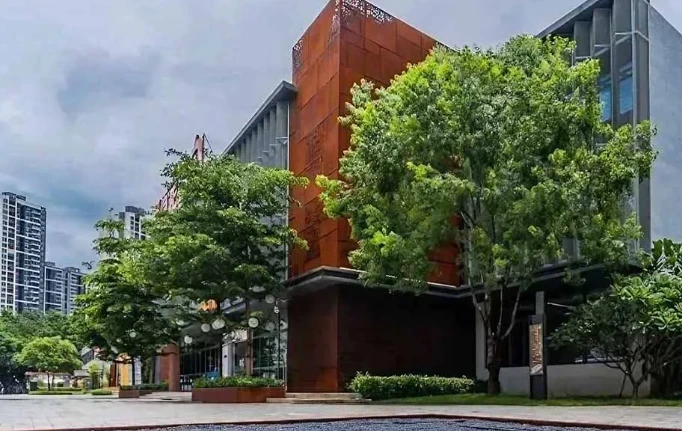
Use of weathering steel
Weathering steel is widely used in artistic creations, hence its nickname "artist's steel." It is also used in architectural structures such as shipping containers, bridges, and chimneys. In recent years, its application as a roofing or cladding material in the construction industry has increased. Weathering steel is also frequently seen as a sound barrier along highways. Furthermore, this material is commonly found in various gardening products, such as flower beds, planters, fences, slatted floors, or garden gates. Fire pits and garden fireplaces are also often made of weathering steel. High temperatures cause weathering steel to oxidize more quickly and form a rust layer faster. Due to its rust resistance, these items can typically last a long time.
Issues to be considered in design and construction
Although weathering steel is oxygen-impermeable, it is still susceptible to wear. Acid rain, hail, or sand abrasion can all cause this. Wear exposes the underlying material, restarting the oxidation process. Therefore, weathering steel may rust through after a period of use. High-salt environments (such as coastal areas or places where salt is used in winter) can also degrade the surface oxide layer.
Weathering steel requires alternating wet and dry conditions to form a good protective coating. If the steel is kept in a damp environment for extended periods, it will eventually rust through. Therefore, during design and construction, it is essential to ensure that no gaps allow water to accumulate. Damp leaves left on the material can also cause problems.
Welding weathering steel requires the use of additives with the same composition as the steel itself. This means that the strength of the filler metal will not exceed that of the base material. This is significantly different from the additives used in welding structural steel. Furthermore, the weld must be smooth to prevent water from seeping into cavities or gaps.
Fasteners such as screws or bolts should be made of weathering steel, but this material is often difficult to obtain. Another option is to use fasteners made of rust-resistant steel, but this increases processing costs.
During the rusting process, rainwater runoff can leave rust marks on the underlying material. This rusting process can take several months.


