


Sourcing Q355NH Corten Steel often leads buyers to question its standard thickness range-and matching the right thickness to project needs is key to balancing structural performance and procurement costs. Many only know common stock thicknesses but overlook the full standard range and how thickness impacts the steel's mechanical properties and fabrication. So what exactly is the standard thickness range for Q355NH, and which thicknesses are practical for different applications? Based on the latest GB/T 4171-2021 standard and industrial supply practice, the core answer is clear: Q355NH Corten Steel has a broad standard thickness range of 2mm to 100mm for plates and strips, with 6mm to 50mm as the most readily available stock range for global projects. Below is a concise, project-focused guide.
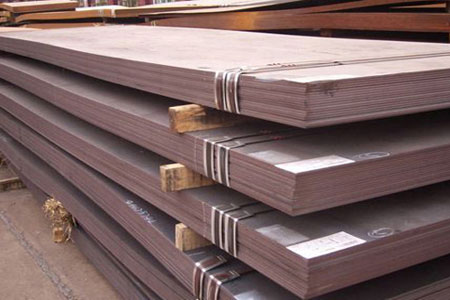
Core Standard Thickness Range (GB/T 4171-2021)
The official Chinese national standard for Q355NH Corten Steel defines a flexible thickness range to suit diverse fabrication and structural needs, with clear dimensional specifications for plates and strips:
Full standard range: 2mm – 100mm (plates/strips); width is paired from 1000mm to 4000mm, with custom lengths available.
Dimensional compliance: All thicknesses meet the standard's tolerance requirements, ensuring uniformity for welding, bending and other forming processes.
Mechanical property adjustment: Yield strength adapts slightly with thickness-≥355MPa for ≤16mm plates, and ≥335MPa for 16mm–40mm plates, with no compromise to core weather resistance.
Most Readily Available Stock Thicknesses
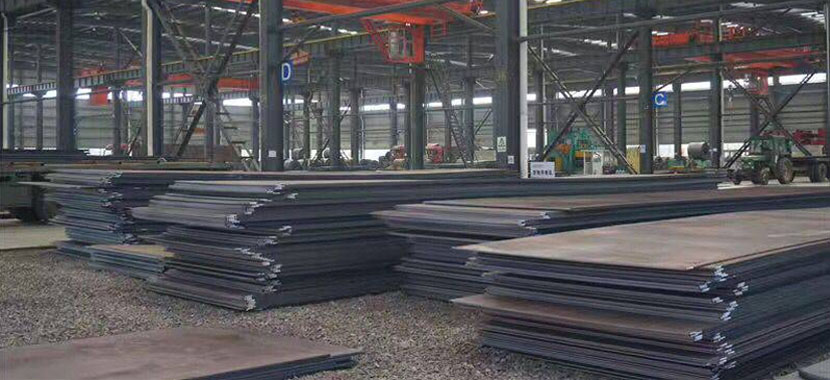
While the standard range is wide, 6mm to 50mm is the mainstream stock thickness for global suppliers, meaning shorter lead times and lower procurement costs with no custom production needed:
6mm–16mm: Ideal for light structural and decorative applications (outdoor cladding, guardrails, billboard supports) with easy laser cutting and forming.
16mm–30mm: The most versatile range for medium load-bearing components (steel columns, small bridge beams, industrial building frames).
30mm–50mm: Suited for heavy-duty structural parts (port machinery, large bridge supports) that require flame cutting for fabrication.
Custom Thickness Options & Practical Limits
For special project needs, Q355NH Corten Steel supports custom thickness production, with clear industrial practical limits to note:
Thin custom range: 2mm–6mm (mainly for automotive and light equipment parts, with strict flatness requirements).
Thick custom range: 50mm–100mm (for ultra-heavy structural projects; requires longer production lead times and third-party quality inspection).
Key note: Custom thicknesses beyond 100mm are not recommended-they compromise the steel's ductility and weldability, and lack standard mechanical property guarantees.
Thickness Selection for Common Applications
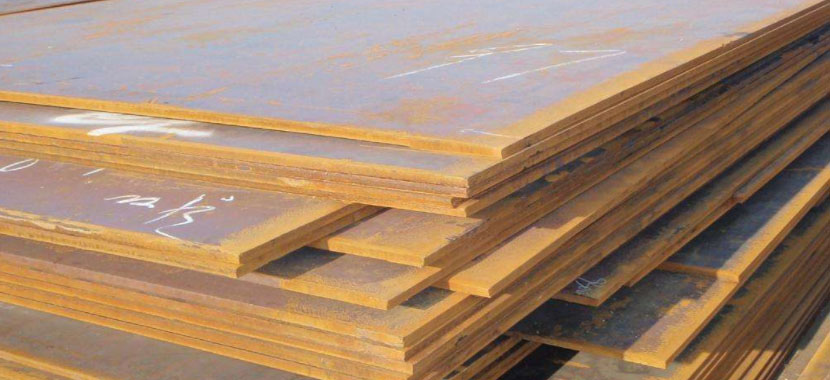
Matching Q355NH thickness to your project directly optimizes performance and cost, with these practical industry recommendations:
Outdoor decoration/cladding: 6mm–12mm (balances light weight and weather resistance, easy to process into special shapes).
Highway/bridge guardrails: 10mm–16mm (resists impact and outdoor corrosion, the most cost-effective choice).
Load-bearing steel structures: 16mm–30mm (meets structural strength requirements for industrial buildings and small bridges).
Heavy industrial equipment: 30mm–50mm (supports heavy loads for port and mining machinery).
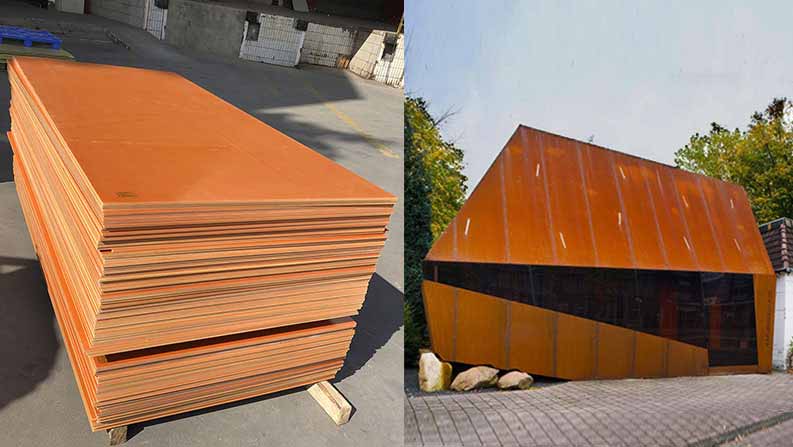
In summary, Q355NH Corten Steel's 2mm–100mm standard thickness range offers great flexibility for global projects, with 6mm–50mm as the practical go-to for most applications. Choosing the right thickness based on load, fabrication and application needs not only ensures structural safety but also minimizes procurement and processing costs-maximizing the value of Q355NH in your project.


