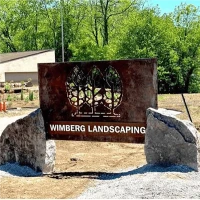
What Is a Corten Steel House Sign?
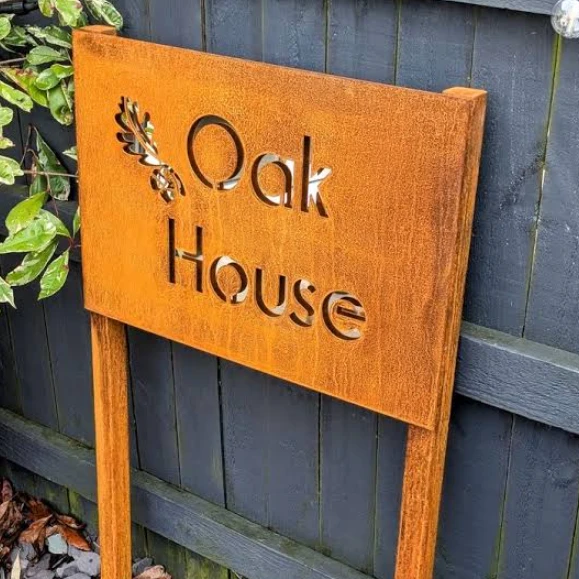
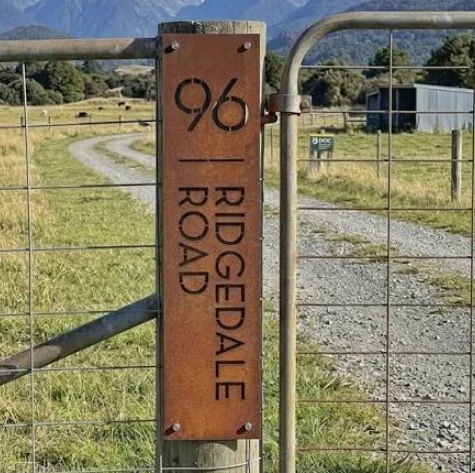
A Corten steel house sign is an exterior sign made from weathering steel, commonly used to display house numbers, street names, family names or property identification.
It can be manufactured as a flat metal plate, a laser-cut number sign, a wall-mounted plaque or a freestanding garden sign. Unlike painted signs that rely on a coating for their appearance, weathering steel gradually develops a rust-colored surface through atmospheric exposure.
At Gnee, corten house signs can be customized according to the required dimensions, lettering, number layout, cut-out patterns and installation method.
Depending on the design, the sign can use raised lettering, through-cut numbers, a solid backing plate or individual metal characters. The material grade and thickness should be selected according to the sign dimensions, installation location and structural requirements.
Why Choose Corten Steel House Signs for Outdoor Use?
1. Corten House Signs Develop a Natural Rust Patina
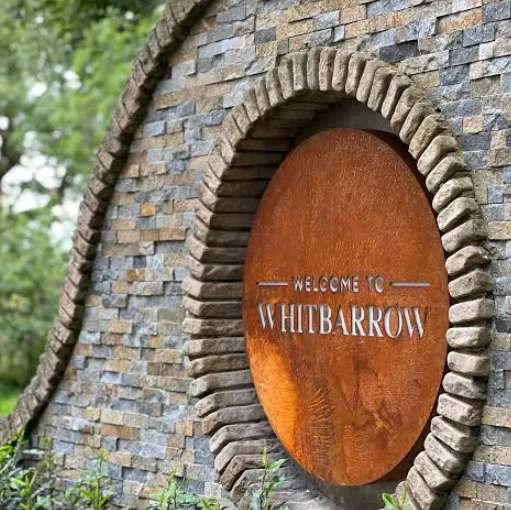
The characteristic appearance of corten house signs comes from the development of an oxide patina on the steel surface. Alloying elements such as copper, chromium and nickel contribute to the formation of a more protective corrosion product under suitable atmospheric conditions.
The surface typically changes from an initial orange or yellow-orange color to brown and eventually a darker brown tone as weathering progresses.
The patina does not form instantly. The development of a relatively stable protective patina commonly takes around 2–6 years, although the time varies with the environment.
During the early exposure period, weathering steel may corrode at a rate comparable to conventional carbon steel. Therefore, a newly installed corten steel house sign should not be expected to have the same mature surface appearance as a sign exposed outdoors for several years.
2. Corten Steel House Signs Have Atmospheric Corrosion Resistance
Weathering steel is designed to form a protective patina during repeated wetting and drying cycles. Once the patina becomes sufficiently stable, it can reduce the rate of further atmospheric corrosion.
After patina stabilization, weathering steel may corrode approximately 4–8 times more slowly than conventional steel under the conditions covered by the reviewed studies. It also reports a steady-state corrosion rate as low as 0.005 mm/year in some medium-corrosivity C3 environments.
For a practical comparison, a corrosion rate of 0.005 mm/year is equivalent to an average thickness reduction of 5 μm per year. If that rate remained constant, the calculated loss would be 0.05 mm over 10 years and 0.10 mm over 20 years.
However, this is only a mathematical illustration based on the reported C3 reference rate. Actual corrosion loss changes with humidity, time of wetness, airborne salt, industrial pollutants, surface orientation and drainage conditions.
|
Research reference |
Value |
Explanation |
|---|---|---|
|
Protective patina development |
Approx. 2–6 years |
Varies with exposure conditions |
|
Corrosion-rate comparison |
Approx. 4–8 times slower |
After patina stabilization in reviewed studies |
|
Reported C3 corrosion rate |
As low as 0.005 mm/year |
Specific medium-corrosivity conditions |
|
Equivalent annual thickness loss |
5 μm/year |
Conversion of 0.005 mm/year |
3. Corten Steel House Signs Offer Structural Strength for Fabrication
The strength of a corten steel house sign depends on the actual steel grade and product thickness. For example, under EN 10025-5, S355J2W weathering steel has a minimum yield strength of 355 MPa for nominal thicknesses up to 16 mm.
For thicknesses above 16 mm and up to 40 mm, the specified minimum yield strength is 345 MPa. Its tensile strength is generally specified as 470–630 MPa for thicknesses from 3 mm to 100 mm. These figures are grade- and thickness-specific standard values, not test results for every finished sign.
For house signs, material thickness should be selected based on the overall dimensions, unsupported span, fixing-point spacing and expected wind exposure.
A small wall-mounted number plate and a large freestanding garden sign do not have the same stiffness requirements. Gnee can review the drawing and recommend a suitable material thickness and reinforcement arrangement. The final specification should be confirmed against the selected grade and its mill test certificate.
4. Custom Laser-Cut Corten Steel House Number Signs
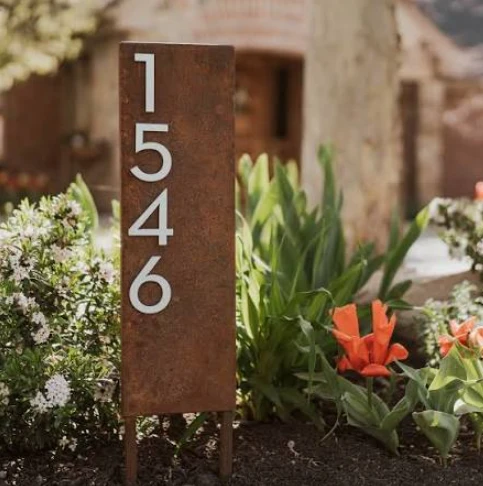
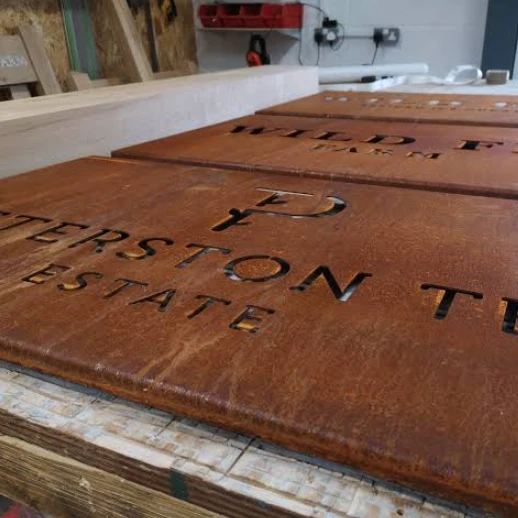
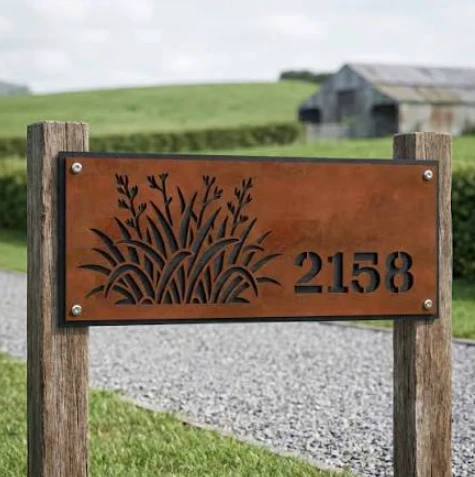
Laser cutting allows numbers, letters, logos and decorative patterns to be cut directly into a corten steel plate. Customers can choose between through-cut numbers, engraved-style visual layouts, separate metal lettering or a solid plate with raised elements. The minimum cut-out size, spacing between characters and edge details should be checked against the plate thickness and the cutting process before production.
For example, a corten steel house number sign can display a large house number in the center, with a street name or family name below it. A backplate can be added to improve visual contrast and simplify installation. For outdoor use, the design should also consider water drainage around cut-outs and mounting holes to reduce areas where moisture can remain trapped.
5. Corten House Signs Can Be Made in Different Mounting Styles
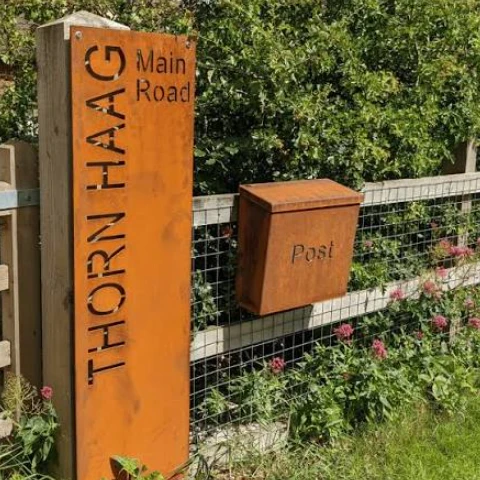
Different properties require different sign configurations. Wall-mounted corten house signs can be supplied with fixing holes, spacers or stand-off mounts.
Freestanding signs can be designed with ground stakes or support posts, depending on their size and installation surface. The mounting method should account for the sign's weight, wind exposure, wall material and the possibility of water collecting behind the plate.
For larger corten steel house signs, additional brackets or a reinforced backing structure may be required. The fixing details should be confirmed before fabrication so that the sign can be installed securely without compromising its appearance.
Custom Corten Steel House Signs from Gnee
Gnee supplies custom corten house signs for residential properties, gardens, entrances and architectural projects. Customers can provide a drawing, reference image or design concept. Our team can review the layout and confirm the material grade, plate thickness, dimensions, cut-out details and mounting method before production.
Available customization options
|
Item |
Customization details |
|---|---|
|
Material |
Weathering steel; grade subject to project confirmation |
|
Thickness |
Selected according to dimensions and structural requirements |
|
Shape and size |
Rectangular, square, circular or custom profile |
|
Lettering |
House numbers, street names, family names and logos |
|
Cutting |
Laser-cut numbers, letters and decorative patterns |
|
Surface |
Natural weathering finish or specified surface treatment |
|
Mounting |
Fixing holes, spacers, brackets, posts or ground stakes |
|
Packaging |
Protective packaging according to product dimensions and shipping method |
How to Order Custom Corten Steel House Signs
To prepare an accurate quotation, please provide the following information:
1. Dimensions: Overall width, height and preferred thickness.
2. Design: House number, text, logo, font style or reference drawing.
3. Material: Required weathering steel grade, if specified.
4. Installation: Wall-mounted, gate-mounted, post-mounted or freestanding.
5. Quantity and destination: Order quantity and delivery country or port.
Send your drawings or reference images to Gnee. We will review the design and provide a suitable material and fabrication proposal for your corten steel house sign.
Request a Quote for Custom Corten Steel House Signs
Send us your required dimensions, design and quantity. Our team will help confirm the material specification, fabrication details and quotation for your project.