


Thickness directly balances S355K2W Corten Steel's load-bearing capacity and low-temperature toughness-critical for -40℃ cold-region structures like alpine bridges or polar supports. Excessive thickness may undermine impact resistance, while limited thickness restricts structural applicability. Two key questions arise for engineers and buyers: What is the maximum available thickness of S355K2W, and how does thickness affect its impact toughness at -40℃? Based on EN standards and industrial production practice, the core conclusion is clear: S355K2W is commonly supplied up to 100mm (customizable to 150mm via special rolling), and thickness mainly affects toughness by altering grain structure-thickness over 25mm requires process control to maintain -40℃ impact performance. Below is a concise, actionable breakdown.

Key Background: Thickness Availability & Production Limits
S355K2W's thickness range is defined by EN 10025-5 and industrial rolling capabilities, with clear boundaries for standard supply and custom production:
Standard supply thickness: 3mm to 100mm (hot-rolled or thermo-mechanical controlled rolling, TMCP). This range covers most cold-region structural needs, from thin plates for cladding to thick plates for load-bearing beams.
Custom thick plates: Thickness up to 150mm is achievable via special hot rolling, but requires strict process control (e.g., slow cooling, post-rolling normalization) to avoid grain coarsening. Thicker than 150mm is not recommended, as it leads to uneven internal structure and unqualified toughness.
Thickness & certification: All standard thicknesses (≤100mm) comply with EN 10025-5, while custom thick plates (100-150mm) need additional EN 10204 Type 3.1 MTR to confirm -40℃ impact energy meets ≥27J.

How Thickness Affects -40℃ Impact Toughness
The core mechanism linking thickness to -40℃ toughness lies in cooling speed during production and welding, which directly affects grain refinement and residual stress:
Thin plates (≤25mm): Fast cooling after rolling/refining forms fine, uniform ferrite-pearlite grains. Even after welding, the heat-affected zone (HAZ) is narrow, and -40℃ impact energy stably stays above 35J (exceeding EN's minimum requirement of 27J).
Thick plates (>25mm): Slow cooling leads to coarse grains; welding further expands HAZ and increases residual stress. -40℃ impact energy gradually decreases-for 50-100mm plates, energy may drop to 27-32J (just meeting the standard limit); for 100-150mm custom plates, without normalization, energy may fall below 27J, risking brittle fracture.
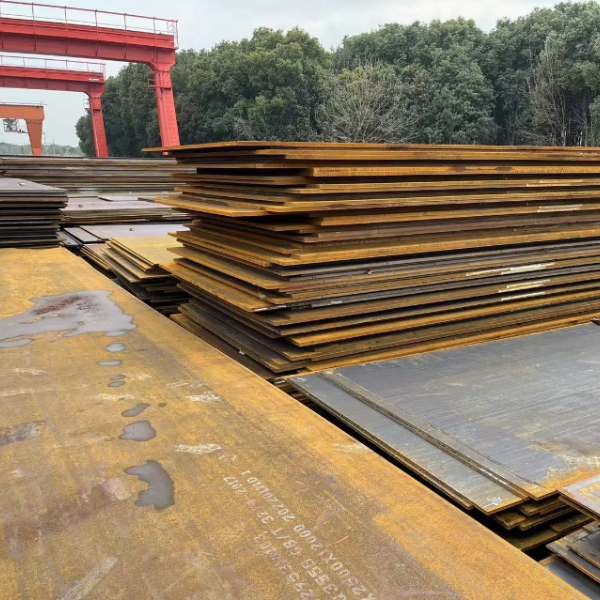
Toughness Performance by Thickness Range
Below is the typical -40℃ impact toughness of S355K2W across thickness ranges (based on TMCP process and post-treatment):
1. ≤25mm: Excellent Toughness, No Additional Control Needed
-40℃ impact energy: 35-50J. Fine grains ensure stable performance; suitable for cold-region components like bridge guardrails or small supports. Welding only requires standard preheating (80-120℃), no post-weld heat treatment.
2. 25-100mm: Moderate Toughness, Process Control Required
-40℃ impact energy: 27-35J. To avoid toughness degradation: ① Use TMCP process for rolling; ② Preheat to 120-150℃ before welding; ③ Conduct post-weld stress relief annealing (550-600℃) for critical components. Suitable for thick load-bearing beams or alpine bridge piers.
3. 100-150mm: Marginal Toughness, Strict Post-Treatment Mandatory
-40℃ impact energy: 27-30J. Must adopt: ① Post-rolling normalization (850-900℃ air cooling) to refine grains; ② Full-penetration welding with low-hydrogen consumables; ③ 100% ultrasonic testing (UT) for internal defects. Only used for special heavy-load structures with no alternative.
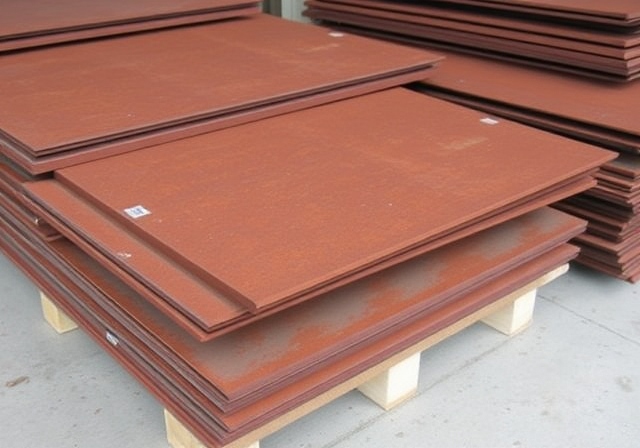
Practical Adaptation Tips for Thick Plates
To maintain -40℃ toughness for S355K2W thick plates, follow these actionable measures:
Procurement: Specify "TMCP process" and "-40℃ impact energy ≥30J" in purchase orders for plates >50mm; request additional normalization certification for 100-150mm plates.
Welding: Avoid high heat input (control at 20-30 kJ/cm); use ER70S-GNiCu consumables to match toughness.
Inspection: Conduct Charpy V-notch impact testing on HAZ after welding for plates >25mm to confirm no toughness loss.

In summary, S355K2W's max available thickness is 100mm (customizable to 150mm), and thickness affects -40℃ toughness by changing grain structure. Plates ≤25mm have excellent toughness, while >25mm need process control and post-treatment to meet safety requirements. Select thickness based on load needs and match corresponding processes to ensure cold-region structural safety.


