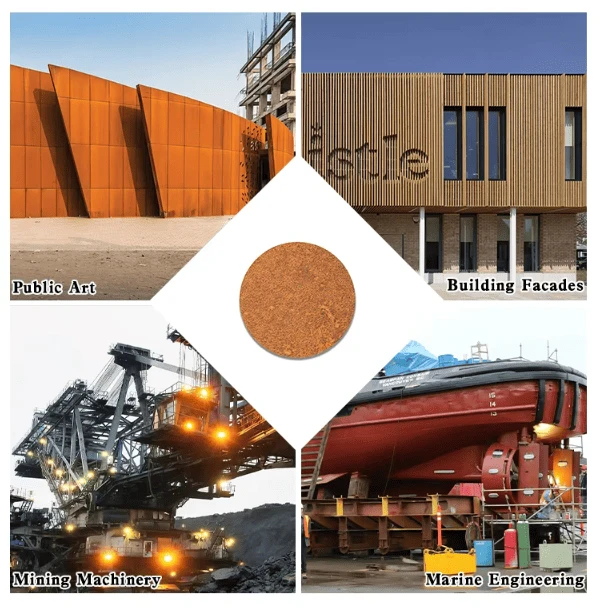
Perforated Corten steel panels have become a standout material in modern architecture due to their unique combination of structural performance, visual appeal, and long-term durability.

Compared to conventional perforated mild steel, Corten steel develops a stable, protective oxide layer that prevents further corrosion, allowing it to be used outdoors without painting or continuous maintenance. This makes it ideal for landscape façades, outdoor art screens, fencing, shading systems, and building cladding.
Below are the key advantages that make perforated Corten steel an excellent choice for designers, builders, and landscape contractors.
1. Natural Weather Resistance with Self-Protective Rust Layer
Unlike standard steel that continues to rust over time, Corten steel forms a dense oxide patina that stops deeper corrosion.
Typical corrosion rate: 0.01–0.03 mm/year, depending on climate
Expected outdoor lifespan: up to 40–80 years without coating
This eliminates the need for repainting and reduces long-term maintenance costs.
2. Strong Structural Performance
Corten steel has a higher tensile and yield strength compared to mild steel, which means thinner sections can be used while maintaining rigidity.
| Property | Corten Steel (ASTM A588) | Mild Steel (A36) |
|---|---|---|
| Yield Strength | 345–485 MPa | 250 MPa |
| Tensile Strength | 470–630 MPa | 400–550 MPa |
Because of this, perforated Corten panels maintain stability even when pierced with artistic or functional patterns.
3. Aesthetic Appeal that Evolves Over Time
The signature orange-brown patina develops naturally when exposed to air and moisture, giving each installation a uniquely organic and ever-changing appearance.
Design flexibility includes:
Geometric perforation patterns
Custom artistic cut-outs
Gradient and variable aperture layouts
This makes it particularly popular for landscape screens, garden edging, façades, and public art installations.
4. Improved Ventilation, Sun Control, and Light Shading
Perforation allows light and wind to pass through while maintaining privacy and shade.
Applications include:
Building sunshades
Semi-private balcony partitions
Pergola or pavilion roofing
Exterior façades with light diffusion effects
Perforated panels help reduce solar heat gain by 10–35%, improving building energy performance.
5. Reduced Water Retention and Enhanced Drainage
When used for flooring, walkways, or stairs, perforated Corten steel allows:
Rainwater to drain instantly
Surfaces to maintain grip due to the oxidation texture
Snow/ice accumulation to reduce faster in exposed areas
This makes it safer and more functional than solid steel or wood decking in outdoor environments.
6. Flexible Fabrication and Customization
Corten steel is easy to cut, perforate, fold, weld, and laser-pattern without compromising strength.
Fabrication options:
CNC punch perforation
Laser cutting for artistic panels
Bending and rolling for curved forms
Welding for frames and modular installations
This allows precise customization for architecture, landscape, and industrial projects.
7. Eco-Friendly and Long Service Life
Because the material does not require repainting or anti-corrosion treatments, it:
Reduces VOC emissions from coatings
Minimizes waste and replacement cycles
Supports sustainable design principles
Its long service life makes it cost-effective over the entire product lifecycle.
Perforated Corten steel panels combine long-term durability, natural weathering beauty, and design flexibility, making them a highly suitable material for modern façades, landscaping structures, and architectural aesthetics.
With customizable patterns and high structural performance, these panels are not just functional components-but also creative elements that define visual identity.