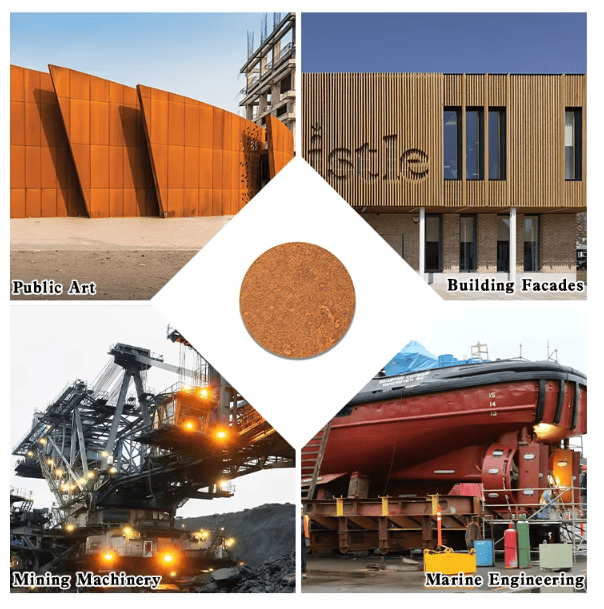
What Are Corten Perforated Panels?
Corten Perforated Panels are architectural panels made from weathering steel that develops a protective oxide patina when exposed to air and moisture.
Unlike ordinary perforated mild steel, the surface rust layer of Corten stabilizes over time and prevents deeper corrosion. These panels are commonly supplied in custom perforation patterns, including round holes, slots, geometric meshes, and decorative cut-outs.

Corten Perforated Panels are widely used in building façades, fences, sunshade screens, balcony partitions, garden structures, gates, and public landscape installations.
Their high strength-to-weight ratio and long-term weather resistance make them suitable for both industrial and architectural applications.
Benefits of Using Corten Perforated Panels
1. Long Service Life in Outdoor Environments
- Corten steel forms a stable rust-passivation layer that protects the steel from further corrosion.
- Patina stabilization period: 3–12 months (depending on humidity, rainfall, and airflow)
- Corrosion rate: 0.01–0.03 mm/year (significantly slower than mild steel)
- Expected outdoor lifespan: 40–80 years, without repainting
This makes Corten perforated panels well-suited for coastal, humid, desert, and temperature-variable climates.
2. High Strength and Structural Stability
| Property | Corten Steel (ASTM A588 / SPA-H) | Mild Steel (A36 / Q235) |
|---|---|---|
| Yield Strength | 345–485 MPa | 235–250 MPa |
| Tensile Strength | 470–630 MPa | 400–550 MPa |
| Density | 7.85 g/cm³ | 7.85 g/cm³ |
Thanks to its higher yield strength, lighter and thinner panels can be used while maintaining stiffness-even with perforation patterns up to 35% open area.
3. Distinctive, Evolving Aesthetic Appearance
The surface patina shifts gradually from orange-brown → deep bronze → smoky cocoa brown over time.
Aesthetic advantages:
Warm, natural tones that blend with stone, concrete, wood, and vegetation
Soft shadow-play when perforations interact with sunlight
Design flexibility (geometric, abstract, patterns, gradient openings)
This makes it popular for landscape architecture and cultural/municipal public spaces.
4. Functional Ventilation, Privacy, and Sun Control
Perforated panels balance airflow, daylight, and visibility:
| Open Area Ratio | Typical Use Performance |
|---|---|
| 15%–22% | Privacy screens, balcony railings |
| 22%–30% | Solar shading, façade ventilation |
| 30%–40% | Acoustic diffusers, airflow panels |
Reduces solar heat gain by 10–35% on façades
Improves natural ventilation efficiency by 5–18%
Supports passive cooling strategies in sustainable architecture
5. Low Maintenance and Long-Term Cost Advantage
Unlike coated or galvanized steel:
No repainting required
No continuous corrosion protection treatments
No flaking or peeling of finish
Maintenance cost is reduced by ~60–80% over a 30-year lifecycle compared with painted steel façades.
6. Flexible Fabrication for Custom Designs
Available fabrication processes:
CNC punching & laser cutting
Bending, folding, rolling
Modular cassette framing
Welding, hem edges, stiffener ribs
Common thickness options:
1.5 / 2.0 / 2.5 / 3.0 / 4.0 / 5.0 mm
Panel sizes available up to:
1500 × 6000 mm (single sheet)
Drawings can be provided in DWG / DXF / AI / PDF format.
Whether used for a façade, landscape fence, garden screen, or shading system, Corten perforated panels introduce texture, depth, and a dynamic visual effect that evolves over time-making every project visually unique.