


Corrosive environments-from mild humidity to harsh salt spray or acidic fumes-are the biggest threat to steel's service life. Q295NH Corten Steel is engineered for weather resistance, but its performance in corrosive settings varies drastically by the type and severity of corrosion. For project planners and buyers, understanding how it holds up under different corrosive conditions is key to avoiding premature failure and wasted costs. How exactly does Q295NH perform in corrosive environments? Based on corrosion test data and field applications, the core conclusion is clear: Q295NH excels in mild-to-moderate corrosive environments but struggles in harsh settings (high salt, strong acids) without additional protection. Below is a concise, actionable breakdown.

Key Background: How Q295NH Resists Corrosion
Q295NH's corrosion resistance relies on a natural protective mechanism, distinct from ordinary carbon steel:
Its chemical composition (Cu 0.20-0.50%, Cr 0.30-1.20%, P 0.07-0.15%) reacts with oxygen, moisture, and trace pollutants in the air.
Over 6-12 months, this reaction forms a dense, adherent patina (a stable rust layer mainly composed of α-FeOOH and γ-FeOOH).
This patina acts as a barrier, blocking moisture and corrosive agents from reaching the steel substrate, slowing corrosion to a fraction of ordinary steel's rate.

Q295NH Performance: By Corrosive Environment Type
Not all corrosive environments are equal-Q295NH's performance, service life, and required protection differ by corrosion severity:
1. Mild Corrosive Environments (C2-C3 Grade)
Typical Settings: Suburban areas, rural regions, and non-industrial urban zones (moderate humidity, low pollution, no salt or acid).
Performance: Excellent. The patina forms evenly and stably, reducing corrosion rate to ≤0.03mm/year.
Service Life: 15-25 years with minimal maintenance (only occasional dust cleaning).
Protection Needed: None-natural patina is sufficient.
2. Moderate Corrosive Environments (C3-C4 Grade)
Typical Settings: Light industrial zones (low acidic fumes, minimal dust) and inland areas near highways (trace salt from de-icing).
Performance: Good, but patina formation is slightly delayed (8-12 months) and may be uneven.
Service Life: 10-15 years with basic protection.
Protection Needed: A thin, breathable anti-corrosion coating (e.g., fluoropolymer topcoat) to reinforce the patina and resist trace pollutants.
3. Harsh Corrosive Environments (C4+ Grade)
Typical Settings: Coastal areas (high salt spray), heavy industrial zones (acidic fumes from smelters/chemical plants), and regions with high humidity (>85%) and frequent rain.
Performance: Poor. Corrosive agents (salt, acids) dissolve the patina, causing pitting and crevice corrosion.
Service Life: Only 3-5 years, even with protection.
Recommendation: Avoid Q295NH. Opt for higher-grade Corten Steel (Q355NH, S355K2W) or stainless steel (316L) instead.

Practical Tips to Improve Q295NH's Corrosion Resistance
For moderate corrosive environments where Q295NH is used, these steps extend its service life:
Pre-Installation Preparation: Shot-blast the surface to remove oil, dust, and loose scale-this ensures uniform patina formation.
Coating Selection: Use a two-layer system (zinc-rich epoxy primer + fluoropolymer topcoat) for moderate corrosion; avoid non-breathable coatings that trap moisture.
Regular Maintenance: Inspect the surface annually; touch up damaged coatings or patina promptly to prevent localized corrosion from spreading.
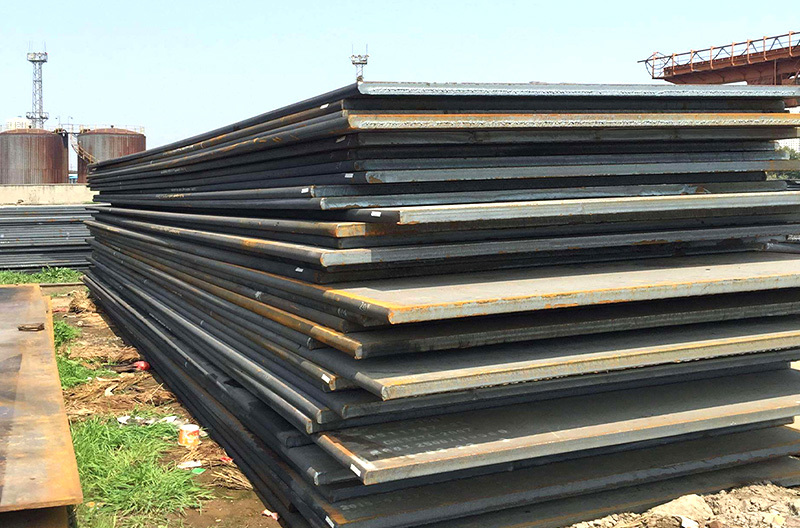
In summary, Q295NH Corten Steel performs reliably in mild-to-moderate corrosive environments, thanks to its protective patina. However, it is not suited for harsh settings like coastal or heavy industrial zones. By matching it to the right corrosion grade and applying basic protection when needed, you can maximize its service life and cost-effectiveness in corrosive conditions.


