


Many users wonder how Q460NH Corten Steel holds up in corrosive environments-after all, its reputation as a weather-resistant material is key, but not all corrosion is the same. Industrial fumes, coastal salt, and humid climates each test the steel differently, and buyers need to know if it can maintain strength and durability long-term. As a high-strength Corten Steel, Q460NH relies on its unique patina for protection, but how does this translate to real-world corrosive conditions? The core answer is clear: Q460NH performs well in mild-to-moderate corrosive environments, but struggles in harsh, high-salt or chemical-rich settings-its patina is effective but not indestructible. Below is a concise, actionable guide.

First: How Q460NH Resists Corrosion (Simplified)
Q460NH's corrosion resistance comes from its alloy composition and natural patina formation-no complex chemistry needed:
Alloy Traits: It contains Cu, Cr, and Ni (compliant with GB/T 4171), which react with oxygen and moisture to form a protective layer.
Patina Role: Over 6-12 months outdoors, a dense, dark gray/brown patina forms on the surface-this acts as a barrier, stopping moisture and corrosive agents from reaching the steel core, while preserving its high strength (yield ≥460MPa).

Q460NH Performance in Different Corrosive Environments
Its performance varies by environment-here's what to expect in the most common corrosive scenarios:
1. Mild Corrosive Environments (Best Performance)
Q460NH excels here, with minimal corrosion and long service life (20+ years):
Environments: Urban/suburban outdoors, low-humidity industrial workshops (no chemical fumes), residential areas.
Performance: Patina forms evenly, corrosion rate ≤0.03mm/year-no rust penetration or strength loss.
Ideal Uses: Outdoor structures, decorative components, light industrial frames.
2. Moderate Corrosive Environments (Good with Minor Protection)
With simple care, Q460NH maintains reliability-minor adjustments prevent premature rust:
Environments: Inland coastal areas (1km+ from shore), workshops with light chemical fumes (e.g., small-scale manufacturing).
Performance: Patina may form unevenly; occasional salt or chemical deposits can cause spotty rust (easily addressed).
Protection Tip: Rinse with fresh water monthly to remove salt/chemical residues.
3. Harsh Corrosive Environments (Poor Performance-Avoid)
Q460NH is not suitable here-corrosion will damage its structure and strength:
Environments: Coastal areas (<1km from shore, direct salt spray), heavy industrial zones (chemical fumes, acid rain), areas with frequent seawater contact.
Performance: Patina breaks down quickly, corrosion rate exceeds 0.1mm/year-rust penetrates the core, weakening tensile/yield strength over time.
Alternative: Use marine-grade steel (e.g., 316L stainless steel) or specialized corrosion-resistant Corten variants.

Practical Tips to Boost Corrosion Resistance
To extend Q460NH's life in moderate corrosive environments:
Ensure good ventilation to speed up uniform patina formation (avoids spotty rust).
Avoid painting/coating (traps moisture); let the patina form naturally.
Inspect annually for spotty rust-remove with a soft brush and rinse with water (no harsh cleaners).
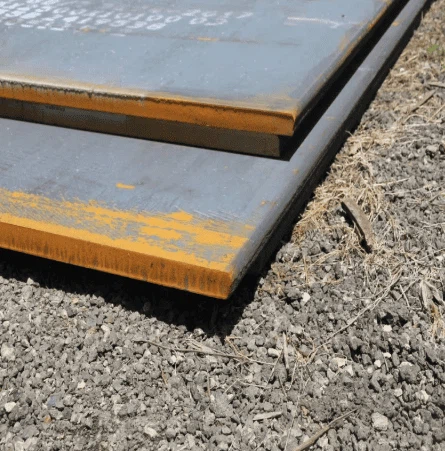
In short, Q460NH Corten Steel performs reliably in mild-to-moderate corrosive environments, thanks to its protective patina. For harsh, high-salt or chemical-rich settings, it's best to choose a more specialized corrosion-resistant material-matching the steel to the environment ensures long-term durability and strength.


