


For projects in inland industrial zones, specifiers and engineers often ask about the viability of bare, unpainted S355J2W Corten Steel. The iconic, self-protecting rust patina is appealing, but how does it withstand an environment with elevated levels of air pollution and industrial fallout?
This article provides a realistic look at the service life of S355J2W in such settings and outlines the key factors to ensure its long-term performance.
How Corten Steel Protects Itself
S355J2W Corten Steel's durability stems from its ability to form a stable, adherent rust patina. Unlike ordinary steel, where rust flakes away and exposes fresh metal to further corrosion, Corten's alloying elements (like copper, chromium, and nickel) promote the formation of a dense, protective oxide layer.
This layer acts as a barrier, dramatically slowing the corrosion rate. Crucially, this process requires alternating wet and dry cycles; the patina cannot form or maintain itself if the steel is constantly wet or damp.
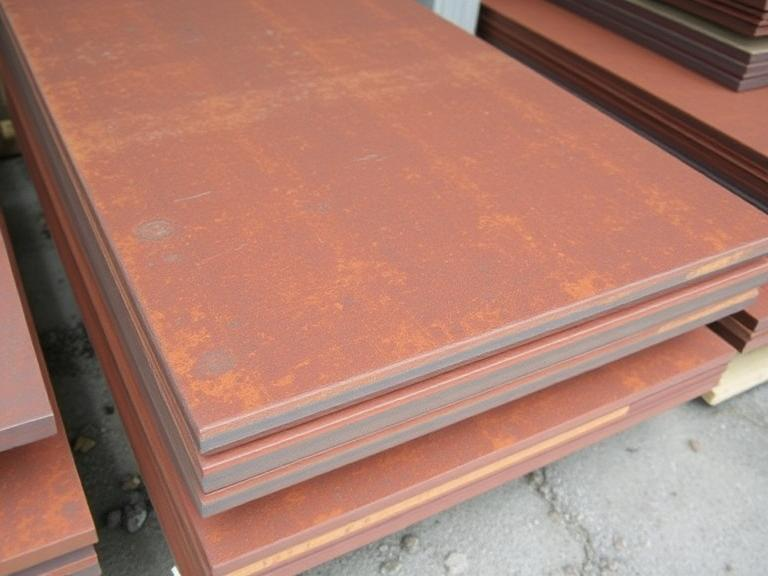
Lifespan in an Inland Industrial Environment: A Realistic View
The term "service life" is intrinsically linked to the loss of material thickness over time. Data from long-term exposure studies provide a clear picture of how Corten performs in different atmospheres.
The table below illustrates the typical corrosion loss over time, comparing environments. Industrial zones present a more challenging condition than rural or urban settings.
| Environment | Typical Airborne Contaminants | Average Corrosion Loss (First 10 yrs) | Average Corrosion Loss (Subsequent 10-yr periods) |
|---|---|---|---|
| Inland Industrial | High sulfur dioxide (SO₂), chlorides, chemical fumes | ~0.20 mm (8 thou) | ~0.10 mm (4 thou) |
| Urban (Moderate Pollution) | Sulfur dioxide | ~0.20 mm (8 thou) | ~0.05 mm (2 thou) |
| Rural (Clean Air) | Minimal pollutants | ~0.10 mm (4 thou) | ~0.05 mm (2 thou) |
Key Implications for Design:
Initial Corrosion: The first decade sees the highest material loss as the protective patina establishes itself.
Long-Term Rate: Once stabilized, the corrosion rate in an industrial zone continues at a steady, predictable pace. Research indicates a long-term steady-state corrosion rate for weathering steel of approximately 5–6 µm (0.005–0.006 mm) per year after the patina is fully formed.
Designing for Lifespan: Therefore, achieving a design life of 50, 80, or 120+ years is entirely feasible. It is accomplished by simply adding a "corrosion allowance" to the initial thickness of the steel member. For example, to ensure a beam has the required structural thickness after 50 years in an industrial zone, you would specify it to be several millimetres thicker at the outset.
Critical Design & Maintenance Considerations for Industrial Sites
To achieve the predicted lifespan, the design must account for the specific challenges of both the industrial macro-environment and the structure's micro-environment.
Facilitate the Wet-Dry Cycle: This is the most critical factor. Design must avoid water traps, ensure rapid drainage, and promote airflow. Details that allow debris to accumulate or moisture to be held against the steel will lead to localized accelerated corrosion.
Avoid Persistent Dampness: The steel must be able to dry out. Locations with persistent high humidity, sheltered from wind and sun, or subject to frequent spray are not suitable for bare Corten.
Manage Direct Exposure to Aggressive Chemicals: While modern air pollution limits often keep general SO₂ levels within a tolerable range for Corten, direct and constant exposure to concentrated chemical fumes from vents or processes should be avoided.
Implement Proactive Maintenance: A simple regimen is essential. This involves regular inspection and cleaning to remove dirt, debris, and chemical deposits that can retain moisture and disrupt the patina.

In summary, bare S355J2W Corten Steel can provide a long, low-maintenance service life in inland industrial zones, with well-documented corrosion rates allowing for precise engineering. The key to success lies not in hoping the material will survive, but in intelligently designing for the environment and committing to basic, proactive care. By respecting these principles, Corten remains a durable, economical, and aesthetically powerful choice for industrial architecture.


