


Surface Treatment, Pre-Weathering, and Sealing Options
Corten steel is often used without surface coatings due to its natural weathering properties. However, depending on the application and desired appearance, there are various surface treatments, pre-weathering, and sealing options available to enhance its aesthetic performance and control the initial weathering process.
The most suitable treatment depends on whether the project requires a naturally developed patina, a faster and more uniform initial appearance, or reduced rust-water staining on surrounding surfaces.

Surface Treatments
Although Corten steel naturally forms a protective patina over time, surface treatments can speed up the initial rusting process and improve surface uniformity. Before treatment, the steel surface should be free from oil, grease, loose mill scale, and other contaminants that may interfere with rust nucleation.
For projects involving abrasive surface preparation, ISO 8501-1 can be used as a reference for evaluating preparation grades such as Sa 2.5. The purpose of surface preparation is to expose a clean and consistent steel substrate rather than to change the inherent weathering characteristics of the alloy.
It is also important to distinguish between surface preparation and pre-weathering. Surface preparation removes barriers from the steel surface, while pre-weathering deliberately accelerates the early formation of the patina.

Pre-Weathering Process
The pre-weathering process involves controlled exposure to moisture and specific chemicals to induce rusting. This process can help achieve a uniform patina quickly, ensuring the steel looks weathered even in its initial stages.
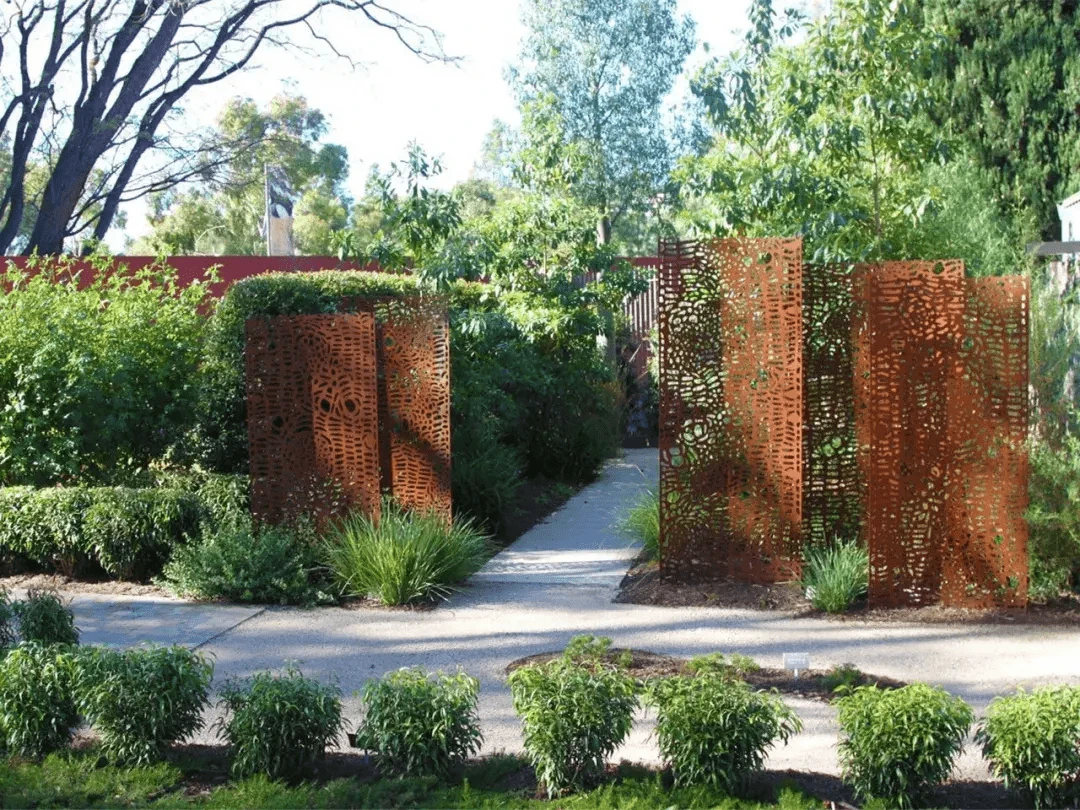
This treatment is commonly used for architectural and landscaping applications where the appearance of the steel is an essential part of the design.
Several practical methods can be used:
Chemical accelerating treatment: A suitable chemical rust accelerator or salt-based solution can be applied by controlled spraying to promote more uniform initial oxidation.
Wet-dry cycling: The steel is repeatedly wetted and allowed to dry, creating alternating moisture and oxygen exposure that accelerates the initial patina formation.
Post-blasting acceleration: After abrasive blasting removes surface contaminants and mill scale, a rust accelerator can be applied to promote a more consistent initial weathering appearance.
Pre-weathering mainly improves the initial appearance and uniformity of the rust layer. It does not fundamentally change the alloy composition or its inherent atmospheric weathering mechanism. The long-term protective patina still develops through the interaction between the weathering steel and its surrounding environment.
The final rate of patina development depends on environmental conditions such as humidity, temperature, rainfall, and exposure to airborne salts. Therefore, pre-weathering should be regarded as an accelerated starting process rather than a guarantee of a fixed final patina color or stabilization time.
Sealing Options
After the patina has developed, some projects may benefit from sealing the surface to reduce staining and moisture interaction. Clear coatings or sealants can be applied to prevent excessive rust runoff or to control the visual appearance of the patina.
Different sealing approaches can be selected according to the project requirements:
Matte acrylic sealers: Suitable where a relatively natural, low-gloss appearance is preferred.
Gloss acrylic sealers: Can provide a more pronounced surface appearance but may change the visual character of the natural patina.
Siloxane penetrating sealers: Designed to reduce water penetration while maintaining more of the original surface appearance.
Specialized weathering-steel sealers: Developed specifically for controlling rust runoff and protecting adjacent architectural surfaces.
The main benefit of sealing is stain and runoff control, particularly where Corten steel is installed near concrete, paving, façades, or other surfaces that could be discolored by rust water. However, sealing also controls the interaction between the steel and moisture, so the subsequent weathering process may be slowed or otherwise altered.
For this reason, sealing should normally be considered when the project prioritizes appearance control or reduction of rust-water staining rather than unrestricted natural weathering.
If a complete coating or protective coating system is specified, ISO 12944 may be used as a relevant reference for corrosion-protection coating systems. For the underlying weathering steel grade, applicable material standards may include GB/T 4171 or JIS G 3125, depending on the specified grade and market.
Maintenance Considerations
Pre-weathered and sealed Corten steel should still be inspected periodically, especially during the early weathering stage. Check for uneven rust development, excessive rust runoff, coating damage, or areas where water remains trapped against the steel.
The maintenance interval should be determined according to the exposure environment and treatment system rather than by a single fixed period. Coastal or salt-exposed environments, frequent wetting, poor drainage, and contact with adjacent porous materials may require more frequent inspection.
In summary, surface preparation removes contaminants, pre-weathering accelerates the initial patina formation, and sealing controls moisture interaction and rust-water staining. Choosing the appropriate treatment therefore depends on whether the project prioritizes natural weathering, faster visual stabilization, or protection of surrounding surfaces.


