


A709 Grade 50W Structural Steel Plate for Bridge Construction
A709 Grade 50W Structural Steel Plate is a high-strength low-alloy weathering steel plate specifically covered by ASTM A709/A709M for bridge structures.
It is widely considered for bridge girders, cross frames, diaphragms, stiffeners, and other load-bearing components. As a steel supplier, Gnee can provide A709 Grade 50W steel plate according to project requirements, including material specifications, plate dimensions, cutting, fabrication, inspection, and export arrangements.
The main advantage of A709 Grade 50W is the combination of structural strength and enhanced atmospheric corrosion resistance. Its minimum yield strength is 50 ksi (345 MPa), while its minimum tensile strength is 70 ksi (485 MPa).
The alloy system includes copper, chromium, nickel, and vanadium, which contribute to weathering performance. Under suitable atmospheric conditions, the steel develops a relatively stable oxide layer that can reduce further corrosion and the need for repeated protective coating maintenance.
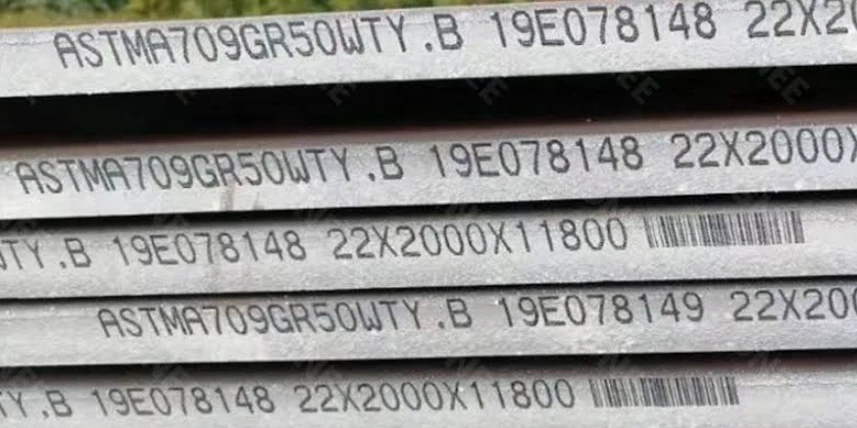
It is important to distinguish A709 Grade 50W from ordinary ASTM A709 Grade 50. Both grades have a nominal minimum yield strength of 345 MPa, but Grade 50W has enhanced atmospheric corrosion resistance requirements.
It is also different from HPS 50W, which is a separate high-performance steel grade with its own chemical composition and mechanical property requirements. Buyers should specify the exact grade in the purchase order rather than simply requesting A709 50 ksi steel.
A709 Grade 50W Chemical Composition and Weathering Performance
The chemical composition of A709 Grade 50W is designed to balance strength, weldability, and atmospheric corrosion resistance. ASTM A709 specifies Type A and Type B chemical composition requirements for Grade 50W.
| Element | Type A (wt. %) | Type B (wt. %) |
|---|---|---|
| Carbon (C) | ≤0.19 | ≤0.20 |
| Manganese (Mn) | 0.80–1.25 | 0.75–1.35 |
| Phosphorus (P) | ≤0.030 | ≤0.030 |
| Sulfur (S) | ≤0.030 | ≤0.030 |
| Silicon (Si) | 0.30–0.65 | 0.15–0.50 |
| Nickel (Ni) | ≤0.40 | ≤0.50 |
| Chromium (Cr) | 0.40–0.65 | 0.40–0.70 |
| Copper (Cu) | 0.25–0.40 | 0.20–0.40 |
| Vanadium (V) | 0.02–0.10 | 0.01–0.10 |
A709 Grade 50W Mechanical Properties for Bridge Structures
A709 Grade 50W is used in bridge structures because it provides a minimum yield strength of 345 MPa and a minimum tensile strength of 485 MPa. Its elongation requirements provide information about the material's ductility under tensile loading.
| Mechanical Property | Requirement |
|---|---|
| Yield Strength | ≥345 MPa (50 ksi) |
| Tensile Strength | ≥485 MPa (70 ksi) |
| Elongation, 2 in. (50 mm) gauge length | ≥21% |
| Elongation, 8 in. (200 mm) gauge length | ≥18% |
| Yield Strength Measurement | 0.2% offset or 0.5% extension under load |
For bridge girders, the plate's strength must be considered together with its thickness, width, unsupported length, connection details, and structural loading.
For example, a 25 mm thick flange plate and a 16 mm thick web plate may both use Grade 50W, but they perform different structural functions. The flange primarily resists bending stresses, while the web mainly transfers shear forces. The final plate thickness and dimensions must be determined by the bridge design calculations.
Impact toughness requirements should also be confirmed in the project specification. Bridge projects may require Charpy V-notch testing according to the applicable ASTM A709 edition, supplementary requirements, service temperature, and member classification.
Buyers should confirm the test temperature, required energy, specimen direction, and acceptance criteria before placing an order instead of assuming that one impact value applies to every Grade 50W plate.
A709 Grade 50W Steel Plate Dimensions and Weight Calculation
| Item | Published Reference Range |
|---|---|
| Thickness | 4.762–76.2 mm |
| Width | 1,800–3,050 mm |
| Length | 6,100–30,480 mm |
| Theoretical Density | 7,850 kg/m³ |
| Plate Size (L × W × T) | Theoretical Weight |
|---|---|
| 6,000 × 2,000 × 16 mm | 1,507.2 kg |
| 6,000 × 2,000 × 20 mm | 1,884 kg |
| 6,000 × 2,000 × 25 mm | 2,355 kg |
| 6,000 × 2,000 × 30 mm | 2,826 kg |
| 6,000 × 2,000 × 40 mm | 3,768 kg |
A709 Grade 50W Steel Plate Applications in Bridge Construction
A709 Grade 50W steel plate is mainly used in structural components that require reliable load-bearing performance and weathering characteristics. In a typical steel bridge, plates can be fabricated into several different components according to the structural drawings.
Bridge Girders and Plate Girders
Bridge girders are primary load-bearing members that transfer loads from the bridge deck to the supports. A709 Grade 50W plates can be used to fabricate girder flanges and webs. The flange plates resist bending stresses, while the web plates transfer shear forces. Plate thickness and width are determined by the structural design, span, loading conditions, and stability requirements.
Cross Frames and Diaphragms
Cross frames and diaphragms connect adjacent girders and help maintain the stability and alignment of the bridge structure. A709 Grade 50W plates can be processed into connection plates, gusset plates, and diaphragm components according to the engineering drawings. Accurate hole positioning and dimensional control are important for assembly at the construction site.
Stiffeners and Connection Plates
Stiffeners reinforce bridge girder webs and help improve resistance to local buckling. Connection plates are used at bolted or welded joints. These components often require CNC cutting, drilling, edge preparation, and accurate marking to match the fabrication drawings.
Outdoor Bridge Structures
The weathering characteristics of Grade 50W make it a potential material choice for certain outdoor bridge structures. However, uncoated use requires suitable environmental conditions and proper structural detailing. Drainage paths, water traps, crevices, and chloride exposure should be considered during the design stage.


A709 Grade 50W Steel Plate Fabrication and Processing Services
Bridge steel projects often require more than standard-size steel plates. The plates may need to be cut into flanges, webs, stiffeners, gusset plates, and other components before they can be assembled into bridge structures. Gnee can discuss processing requirements according to customer drawings and project specifications.
| Processing Service | Technical Details | Typical Application |
|---|---|---|
| CNC Flame Cutting | Profile cutting according to CAD/DXF drawings | Thick plate components, webs and flanges |
| Plasma Cutting | CNC cutting for profiles and openings | Connection plates and shaped parts |
| Laser Cutting | High-precision cutting where thickness and equipment capacity permit | Smaller or precision components |
| Drilling and Hole Making | Bolt-hole positioning according to fabrication drawings | Splice plates and connection plates |
| Edge Milling / Beveling | Edge preparation for specified weld joints | Welded bridge components |
| Plate Shearing | Straight-line cutting within equipment capacity | Rectangular plate blanks |
| Welding and Assembly | According to approved drawings and qualified welding procedures | Fabricated structural components |
| Shot Blasting / Surface Preparation | Surface preparation according to the agreed coating or finishing specification | Components requiring specified surface treatment |


For bridge components, processing accuracy directly affects fabrication and installation. For example, connection plates may require bolt holes with specified diameters, spacing, and edge distances.
If a plate is cut into a girder web, the cut profile and dimensions must match the fabrication drawing. Bevel angles, root gaps, and welding details should follow the approved welding procedure rather than being selected arbitrarily.
Weathering steel also requires appropriate fabrication and surface management. Cutting edges, weld areas, and surfaces exposed to contamination should be handled according to the project requirements.
If the final design requires an uncoated weathering surface, the use of temporary coatings, marking materials, and cleaning methods should be reviewed to avoid interfering with the intended surface condition.
A709 Grade 50W Export Inspection and Quality Control
For bridge steel orders, export inspection should cover material verification, mechanical testing, chemical composition, dimensional inspection, surface condition, marking, and document traceability.
A mill test certificate alone does not replace all project-specific inspection requirements. The inspection scope should be agreed upon in the purchase order before production and shipment.
| Inspection Item | What Is Checked | Relevant Standard / Document |
|---|---|---|
| Material Identification | Grade, heat number, plate marking | ASTM A709/A709M, purchase order |
| Chemical Analysis | C, Mn, P, S, Si, Ni, Cr, Cu, V | ASTM A709/A709M; mill test certificate |
| Tensile Test | Yield strength, tensile strength, elongation | ASTM A370 |
| Impact Test | Charpy V-notch energy and test temperature, when specified | ASTM A673/A673M or applicable project requirement |
| Dimensions | Thickness, width, length, flatness and agreed tolerances | ASTM A6/A6M and purchase order |
| Surface Inspection | Lamination, cracks, visible defects and surface condition | Applicable product specification |
| Ultrasonic Testing | Internal discontinuities, when specified | ASTM A578/A578M or agreed requirement |
| Third-Party Inspection | Witnessing, sampling, document review and final inspection | Inspection and test plan (ITP) |
| Document Review | MTC, test results, packing list and shipping documents | Purchase order and export requirements |
The tensile test is used to verify whether the steel meets the specified yield strength, tensile strength, and elongation requirements. Chemical analysis confirms the heat composition.


For example, a Grade 50W Type A plate should be checked against the applicable Type A limits, including carbon not exceeding 0.19%, chromium between 0.40% and 0.65%, and copper between 0.25% and 0.40%. The actual test results should be traceable to the heat number shown on the plate and its mill test certificate.
Dimensional inspection is especially important for bridge fabrication because plate thickness and geometry affect fit-up, welding, and assembly.

Thickness should be measured at agreed locations, while width and length should be checked against the purchase order. If ultrasonic testing is required, the inspection level and acceptance criteria should be specified in advance.
ASTM A578/A578M is one commonly referenced ultrasonic examination standard for straight-beam testing of rolled steel plates, but it should only be applied when required by the contract or project specification.
Before shipment, the supplier should also check plate markings, bundle identification, quantity, packing condition, and shipping documents. The mill test certificate should include the relevant material grade, heat number, chemical analysis, and mechanical test results. If a third-party inspection agency is appointed, its inspection scope and release procedure should be agreed upon before the goods are dispatched.
Vietnam Export Case: A709 GR.50W Weathering Steel Plates and Pipes
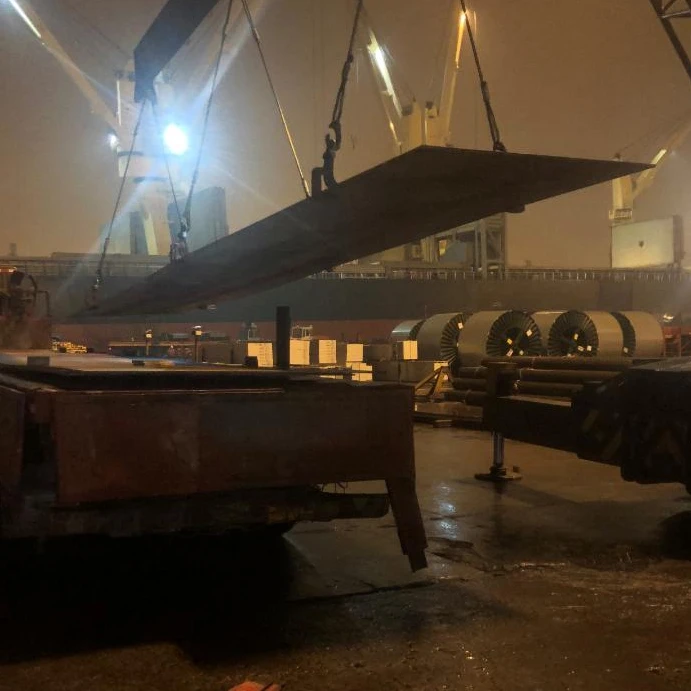
Gnee has previously handled an export order involving A709 GR.50W weathering steel plates and steel pipes for a customer in Vietnam.
The available project records include factory production, warehouse stock preparation, finished-product inspection, and bulk vessel loading. This case reflects the practical coordination required when supplying weathering steel products for overseas construction and structural projects.
During the preparation stage, the products were organized for shipment and checked before loading. For steel plate and pipe orders, product identification, dimensions, quantities, and surface condition should be verified against the confirmed order details. These checks help reduce the risk of specification discrepancies and make it easier for the buyer to receive and identify the materials after arrival.
For bulk vessel shipments, loading arrangements should consider the cargo dimensions, weight distribution, lifting points, and securing method.
Steel products should be positioned and secured to minimize movement, collision, and damage during sea transportation. The final loading plan should be coordinated with the vessel operator and the applicable cargo-handling requirements.
This Vietnam export case demonstrates Gnee's experience in coordinating weathering steel product preparation and overseas shipment. For confidentiality and accuracy, specific order tonnage, plate dimensions, project name, and delivery date should only be published when confirmed by the corresponding order documents.


Buyers planning similar bridge steel purchases can provide their grade, dimensions, quantity, destination port, and inspection requirements for a project-based supply proposal.
Export Packing and Shipping of A709 Grade 50W Steel Plate
Export packing should be selected according to plate dimensions, unit weight, transportation method, destination requirements, and unloading conditions.
For heavy bridge steel plates, the packing and lifting arrangement should provide sufficient support and allow safe handling by cranes or other loading equipment. Bundle identification and shipping marks should also be clear enough for warehouse management and destination inspection.
Depending on the destination country and the packaging material, wooden pallets or wooden supports may be subject to ISPM 15 requirements. Solid wood packaging material used in international trade generally needs to comply with the applicable treatment and marking requirements.
Plywood and other processed wood products may be treated differently under the relevant rules. The buyer and supplier should confirm the destination country's import requirements before packing.
The shipping documents may include the commercial invoice, packing list, bill of lading, mill test certificate, certificate of origin, and inspection documents when required by the contract or destination customs. The exact document set depends on the sales contract, shipping terms, and import regulations.
Order A709 Grade 50W Structural Steel Plate From Gnee
Choosing the right A709 Grade 50W Structural Steel Plate involves more than confirming the steel grade. Plate dimensions, mechanical properties, chemical composition, environmental conditions, fabrication requirements, inspection scope, and export arrangements all need to match the bridge project. Gnee can discuss material supply and drawing-based processing requirements for A709 Grade 50W steel plate orders.
Send us your required grade, thickness, width, length, quantity, processing drawings, destination port, and inspection requirements. Our team can review your specifications and prepare a quotation for your bridge steel project.
Contact Gnee today for A709 Grade 50W steel plate supply, fabrication, and export services.


