


The core principle behind Corten steel's "Corten" (i.e., excellent resistance to atmospheric corrosion) is the formation of a dense, stable, and strongly adhering protective rust layer on its surface through the regulation of alloying elements. This achieves a self-protective effect of "rust prevention with rust." Its weathering mechanism can be analyzed from three aspects: the role of alloying elements, the rust layer evolution process, and the protective mechanism.

1. Copper (Cu, 0.25-0.55%):
Core weathering element, catalyzes the formation of a dense rust layer
Improves rust layer adhesion and stability
Excessive content can easily lead to hot brittleness
2. Chromium (Cr, 0.30-1.25%):
Enhances passivation ability and stabilizes rust layer structure
Improves heat resistance and oxidation resistance
Forms a Cr₂O₃ protective film, preventing corrosion from penetrating deeper
3. Nickel (Ni, ≤0.65%):
Enhances low-temperature toughness and improves fatigue resistance
Improves acid and salt spray corrosion resistance
Promotes uniform distribution of alloying elements
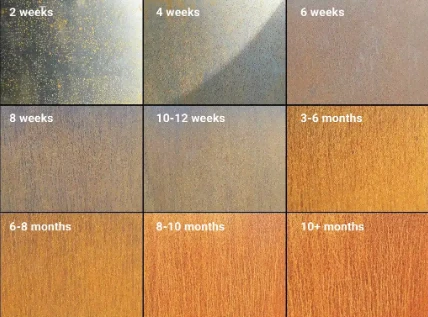
Corten Steel Color Change
4. Phosphorus (P, 0.07-0.15%, high-P type):
Improves initial corrosion resistance and accelerates the formation of a protective film
Decreases weldability, requires balanced use
High-P type (COR-TEN A) has better weather resistance but poor weldability
5. Silicon (Si, (0.15-0.75%):
Strengthens the ferrite matrix and increases strength
Promotes the formation of a protective rust layer
Enhances resistance to high-temperature oxidation
Synergistic effect: When the total Cu+Cr+Ni content is ≥0.80%, a stable α-FeOOH nanocrystalline rust layer is formed, with a permeability only 1/5 that of ordinary carbon steel rust, effectively preventing further corrosion.


