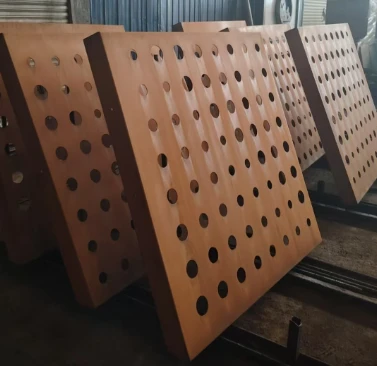
Fabricating Corten steel perforated panels requires a strategic blend of precision machining, material-specific techniques, and attention to detail-critical for preserving the material's corrosion resistance and aesthetic appeal. From cutting crisp perforations to achieving smooth bends and promoting uniform patina, each step demands adherence to Corten's unique properties (e.g., alloy composition, workability).
Core Fabrication Processes
Cutting Perforations: Laser cutting is the gold standard for Corten steel (thickness 1–10mm), using a fiber laser (1000–4000W) to deliver ±0.1mm hole tolerance, sharp edges, and minimal heat-affected zones (HAZ)-preventing warping or material weakening. For thicker panels (10–25mm), plasma cutting (with air or oxygen assist) is viable, though hole precision may decrease to ±0.5mm. Both methods require digital CAD files to map perforation patterns (geometric, custom motifs) and ensure consistent spacing (minimum hole center distance = 1.5x hole diameter).
Bending: Corten's ductility varies by thickness, so bending requires radius dies (minimum 1.5x material thickness) to avoid cracking-especially for panels ≥6mm. Bends should be positioned at least 2x the hole diameter away from perforation lines to maintain structural integrity; for complex shapes, incremental bending (10–15° per pass) reduces stress. Hydraulic press brakes with CNC controls are recommended for accuracy, ensuring uniform angles across large panels.
Finishing: Surface preparation is critical for patina development. First, degrease panels with a petroleum-based solvent (e.g., mineral spirits) to remove manufacturing oils. Next, sandblast with 80–120 grit aluminum oxide to eliminate mill scale and create a rough surface texture-promoting even patina adhesion. For pre-weathered finishes, panels are exposed to controlled humidity (80–90%) and temperature (20–25°C) for 1–2 weeks, or treated with acid-based solutions (e.g., phosphoric acid) to accelerate patina formation. Finally, rinse with fresh water and air-dry to remove residues.
Q: What laser cutting parameters work best for thin vs. thick Corten steel?
A: For 1–5mm panels: 1000–2000W fiber laser, cutting speed 3–5m/min, assist gas (nitrogen) to prevent oxidation. For 6–10mm: 3000–4000W laser, speed 1–2m/min, oxygen assist for faster cutting (with minor edge oxidation, removable via sandblasting).
Q: How to avoid galvanic corrosion during fabrication?
A: Use Corten-compatible tools (stainless steel or Corten contact parts) and fasteners (ASTM A485 stainless steel). Avoid contact with carbon steel tools-iron particles can contaminate Corten's surface, causing uneven rusting. Clean tools between uses to prevent cross-contamination.
Q: Can Corten perforated panels be bent into curved shapes?
A: Yes-for mild curves (radius ≥500mm), use a roll bender with rubberized rollers to protect the surface. For tight curves, heat the bending area to 300–400°C (avoid exceeding 500°C, as it weakens Corten's alloy properties) and use a mandrel to maintain hole shape during bending.
Q: What's the maximum panel size for fabrication without warping?
A: Optimal panel size is ≤3m (length) x 1.2m (width) for 1–6mm thickness; larger panels may warp during cutting or bending. For oversized projects, fabricate smaller sections and join them with Corten-compatible welds (using E7018 electrodes) followed by sandblasting to blend seams.
Q: How to ensure consistent patina across all fabricated panels?
A: Standardize finishing processes: use the same sandblasting grit, degreasing solvent, and pre-weathering conditions for all panels. Avoid exposing partially finished panels to outdoor elements, as inconsistent moisture/UV exposure leads to uneven patina. Package finished panels in breathable plastic to protect from contaminants before installation.