


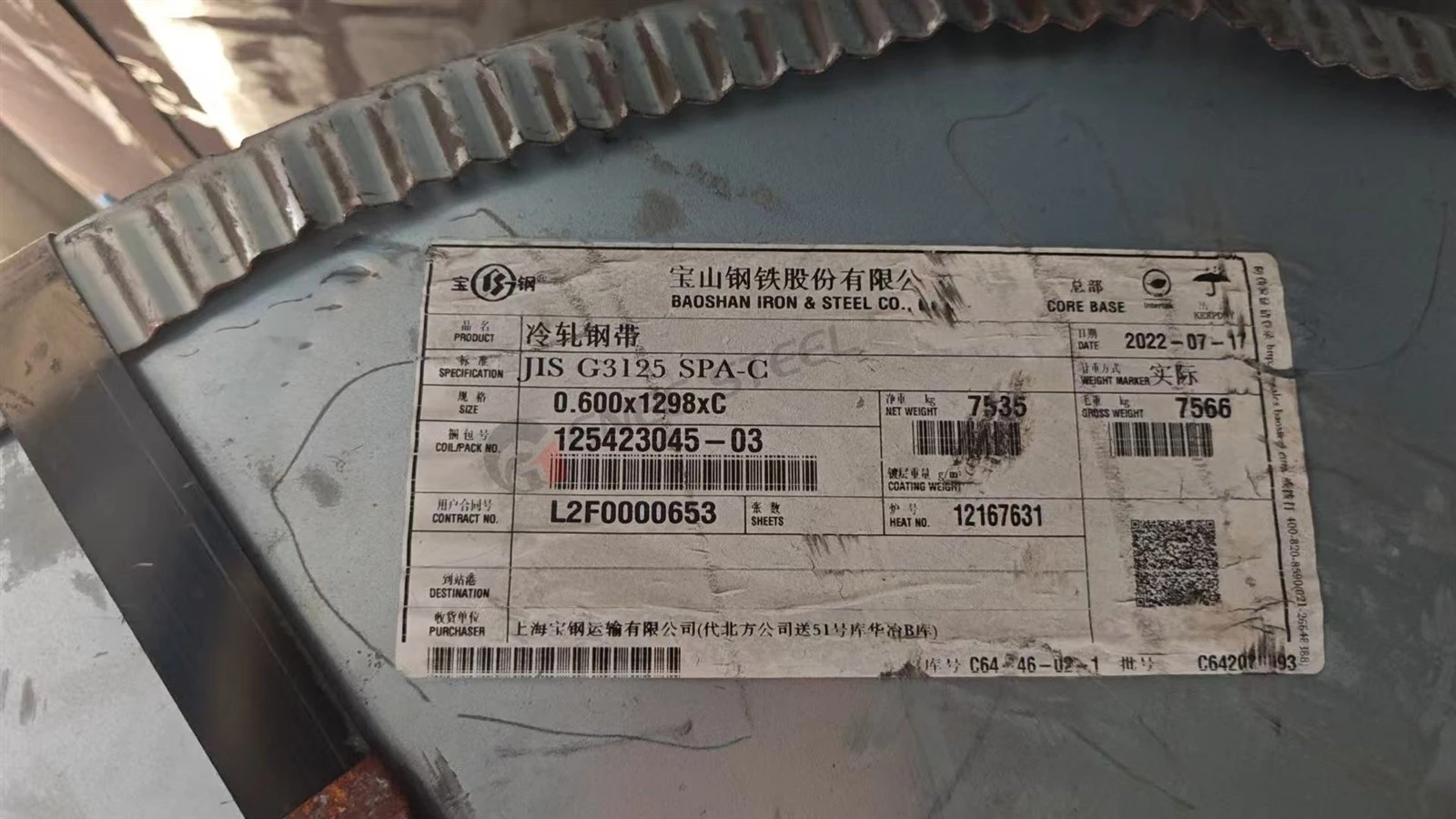
For customers planning to use SPA-C Corten Steel (JIS G 3125 standard) in low-temperature environments, understanding its minimum impact energy requirement is critical to avoid brittle fracture risks. The core answer is: ≥27J at -20℃ (mandatory); no official requirement at -30℃, but performance degrades significantly. This article clarifies the standard specifications, influencing factors, and practical application guidelines.

1. Official Minimum Impact Energy Requirements (JIS G 3125)
The JIS G 3125 standard clearly defines SPA-C's low-temperature impact energy requirements, with key details for foreign customers:
At -20℃: The minimum Charpy V-notch (CVN) impact energy is 27J (3 specimens average; no single specimen below 21J). This is a mandatory requirement for SPA-C to ensure ductility and avoid brittle fracture in general low-temperature scenarios.
At -30℃: There is no official mandatory requirement in the standard. Industrial practice shows that SPA-C's impact energy at -30℃ typically drops to 15-20J, which is below the safe threshold (27J) for load-bearing structures, increasing brittle fracture risks.

2. Key Factors Affecting SPA-C's Low-Temperature Impact Energy
Chemical Composition: SPA-C's Cu-Cr-P alloy system (no mandatory Ni, Nb/V addition) limits its low-temperature toughness. Higher P content (0.07-0.15%) improves weather resistance but slightly reduces low-temperature ductility compared to grades with Ni (e.g., ASTM A588 Grade K).
Sheet Thickness: Impact energy decreases with increasing thickness. For thin sheets (≤6mm), impact energy at -20℃ is usually 30-40J (exceeding the minimum requirement); for thick sheets (≥12mm), it may drop to 27-32J (barely meeting the standard).
Production Process: Hot-rolled SPA-C has better low-temperature toughness than cold-rolled. Controlled rolling and cooling (CRC) processes can refine grains, increasing impact energy by 10-15% compared to conventional rolling.
3. Practical Application Recommendations for Low-Temperature Environments
Applicable Temperature Range: Use SPA-C only in environments ≥-20℃. Avoid direct use in ultra-low-temperature regions (≤-30℃); if unavoidable, replace with grades with higher low-temperature toughness (e.g., ASTM A588 Grade K, ≥27J at -40℃).
Thickness Selection: For low-temperature (-10℃ to -20℃) load-bearing structures, choose thin to medium-gauge SPA-C (≤8mm) to ensure sufficient impact energy. For thick-gauge components, require mill test reports (MTRs) to verify -20℃ impact energy data.
Welding & Post-Treatment: Use low-temperature-resistant welding consumables (e.g., ER50-GNiCuCr) and control interlayer temperature (≥10℃) to avoid reducing the heat-affected zone's toughness. No post-weld heat treatment is needed, but grind weld seams to remove stress concentration points.

In summary, SPA-C Corten Steel meets the 27J impact energy requirement at -20℃ but is not suitable for -30℃ environments due to unregulated and insufficient toughness. Selecting appropriate thicknesses and avoiding ultra-low temperatures ensures structural safety when using SPA-C in low-temperature scenarios.


