


Under optimal conditions, a corten standing seam roof can achieve a service life of 50 to 100 years, making it one of the most durable roofing systems in modern construction.
Whether used in residential architecture or large-scale commercial projects, corten steel standing seam roofing is widely recognized for its ability to outperform traditional materials over the long term.
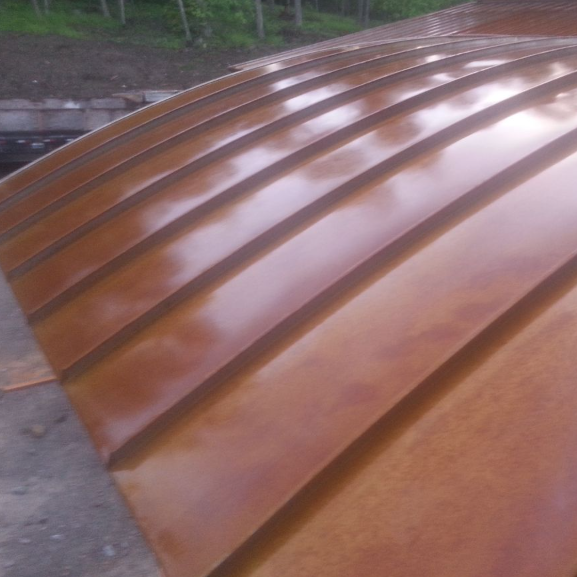
corten standing seam roof
Unlike conventional carbon steel, which corrodes progressively until structural failure occurs, corten standing seam systems develop a stable oxide layer (patina) on the surface.
This layer acts as a natural barrier, protecting the underlying steel from further corrosion and significantly extending the lifespan of the entire roofing system.
2. The Science of Longevity: Why Corten Performs Exceptionally Well
2.1 Advanced Alloy Composition
The durability of standing seam corten materials comes from their unique alloy composition, which is specifically designed to resist atmospheric corrosion.
- Copper (Cu): Enhances corrosion resistance and accelerates the formation of a protective patina
- Chromium (Cr): Improves oxidation resistance and strengthens the stability of the oxide layer
- Nickel (Ni): Increases toughness and ensures the patina remains dense and well-adhered
Together, these elements create a compact and self-healing protective layer, allowing corten standing seam roofing systems to maintain structural integrity for decades without external coatings or treatments.
2.2 Standing Seam System: A Structural Advantage
The design of a corten standing seam roof is just as important as the material itself.
Traditional metal roofs rely on exposed fasteners, which require drilling holes into the panels. These penetrations often become the starting points for corrosion, especially in long-term outdoor exposure.
In contrast, corten steel standing seam roofing systems use:
- Concealed clips
- Raised interlocking seams
- No exposed screw penetrations
This design eliminates one of the most common failure mechanisms in metal roofing. As a result, standing seam corten systems offer superior waterproofing, reduced maintenance needs, and significantly longer service life.
3. Critical Factors That Influence Life Expectancy
3.1 Environmental Conditions
The performance of corten standing seam applications is highly dependent on environmental conditions.
Corten steel performs best in climates with alternating wet and dry cycles. These conditions allow the protective patina to form and stabilize effectively.
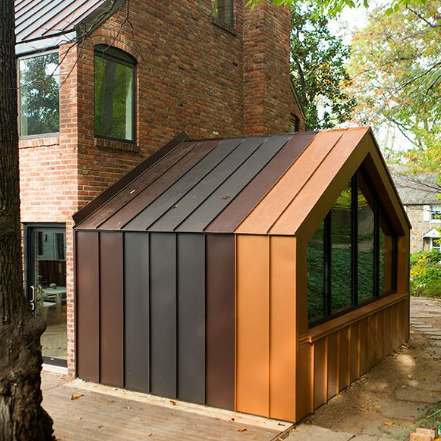
corten standing seam
However, certain environments can reduce the lifespan of both corten standing seam roofing and corten standing seam cladding systems:
- Constant humidity or water exposure prevents proper patina formation
- Poor ventilation slows down drying cycles
- Coastal environments (within 2 km) introduce salt particles that damage the protective layer
In high-salt or continuously wet environments, corten steel may lose its self-protective properties and behave more like ordinary steel.
3.2 Drainage and Roof Design
A key principle in designing corten standing seam roof systems is proper drainage.
As industry experts often say:
"Corten steel loves the rain but hates standing water."
To maximize the lifespan of corten standing seam roofing, it is essential to:
- Ensure sufficient roof slope
- Avoid water accumulation areas
- Design efficient drainage systems
Poor drainage can lead to localized corrosion, especially in low نقاط or flat sections, ultimately reducing the expected service life of the system.
4. Life Cycle Cost (LCC): A True Long-Term Investment
4.1 Traditional Roofing Systems
Traditional roofing materials may appear cost-effective initially, but they often require:
Regular repainting or recoating
Ongoing maintenance
Replacement every 15–20 years
These factors significantly increase long-term costs.
4.2 Corten Standing Seam Roofing
In comparison, corten steel standing seam roofing offers a long-term, low-maintenance solution:
- No need for painting or protective coatings
- Naturally resistant to corrosion
- Minimal maintenance over decades
- High residual value at end of life
Both corten standing seam roof and corten standing seam cladding systems provide excellent lifecycle value, especially in projects focused on durability and sustainability.
4.3 Final Cost Perspective
From a lifecycle perspective, investing in a corten standing seam system means significantly lower total cost of ownership (TCO). It is an ideal solution for developers and architects who prioritize long-term performance over short-term savings.
5. Professional Tips for Buyers and Project Owners
5.1 Choose the Right Thickness
For optimal performance of corten standing seam roofing systems:
- Minimum recommended thickness: 1.0 mm
- Preferred thickness: 1.2 mm or higher
Thicker panels ensure better durability, structural strength, and long-term reliability.
5.2 Avoid Galvanic Corrosion
When installing standing seam corten systems, avoid direct contact with incompatible metals such as galvanized steel or lead. These combinations can cause galvanic corrosion, accelerating material degradation.
5.3 Consider Pre-Patina Treatment
To improve the early-stage performance of corten standing seam roof applications, pre-patina treatment is highly recommended.
This process:
- Accelerates the formation of a stable oxide layer
- Reduces rust runoff and staining
- Provides a more uniform architectural appearance
It is particularly beneficial for high-end projects using corten standing seam cladding or visible roofing systems.
Built for Long-Term Performance
A corten standing seam roof is not just a roofing solution-it is a long-term investment in durability, aesthetics, and cost efficiency.
With a lifespan of 50–100 years, minimal maintenance requirements, and strong environmental resistance, corten steel standing seam roofing stands out as one of the most reliable choices for modern construction.
For projects seeking a balance between performance, design, and lifecycle value, corten standing seam systems remain a leading solution in both roofing and cladding applications.
Contact now to get Standing Seam Corten Steel Roof Systems Quote
Q: Will the rust runoff from the roof stain my building's facade or surrounding pavement?
A: During the initial weathering phase (usually the first 6–18 months), Corten steel produces "bleeding" or runoff when it rains. This iron oxide can stain porous materials like light-colored stone, concrete, or wood.
Our Solution:
Pre-weathering Service: We can provide pre-oxidized panels to shorten the onsite bleeding period.
Drainage Design: We recommend integrated gutter systems and downspouts that direct runoff away from the building envelope and into specialized drainage.
Protective Coatings: Temporary sacrificial coatings can be applied, though they are rarely recommended for roofs as they interfere with the natural patina process.
Q: How long will a Corten standing seam roof last? Does it eventually rust through?
A: When installed correctly, a Corten roof can last 40 to 60 years. The "rust" is actually a dense protective layer (patina) that slows down further corrosion. Unlike mild steel, the corrosion rate of Corten stabilizes once the patina is formed.
Critical Note: The roof must be allowed to go through dry-wet cycles. If the steel remains permanently damp (due to standing water or debris), it will eventually corrode through. Proper pitch and drainage are essential.
Q: Can I install a Corten roof if my project is near the ocean?
A: We generally do not recommend raw Corten steel for projects within 2km (approx. 1.2 miles) of the coastline. High concentrations of salt spray (chlorides) prevent the protective patina from stabilizing and can cause rapid "pitting" corrosion. For coastal projects, we recommend High-Durability Aluminum with a "Corten-look" finish (PVDF coating).
Q: My roof arrived looking like grey steel. When will it turn orange/brown?
A: Corten is typically shipped in its un-weathered state (blue-grey). The transformation depends on your local climate:
Orange/Bright Red: 1–3 months of exposure.
Deep Brown/Chocolate: 1–2 years.
Dark Purple/Stable Patina: 5+ years.
If you require a specific aesthetic from Day 1, please ask about our chemical accelerated weathering process.


